
Senior central bankers from around the world issued a rare joint statement on Tuesday expressing support for Jerome Powell, following confirmation that U.S. federal prosecutors have opened a criminal investigation involving the head of the Federal Reserve.
“We stand in full solidarity with the Federal Reserve System and its Chair Jerome H. Powell,” the statement said, underscoring what the signatories described as the fundamental importance of central bank independence. Among those endorsing the message were Christine Lagarde, president of the European Central Bank, and Andrew Bailey, governor of the Bank of England.
“The independence of central banks is a cornerstone of price, financial and economic stability in the interest of the citizens that we serve,” the statement said. “It is therefore critical to preserve that independence, with full respect for the rule of law and democratic accountability.”
The signatories praised Powell’s record in office, saying he has served “with integrity,” remained focused on the Federal Reserve’s mandate, and demonstrated an “unwavering commitment to the public interest.” They added that he is “a respected colleague who is held in the highest regard by all who have worked with him.”
Central bank leaders from Brazil, Switzerland, Sweden, Denmark, South Korea, Australia, and Canada also joined the statement.
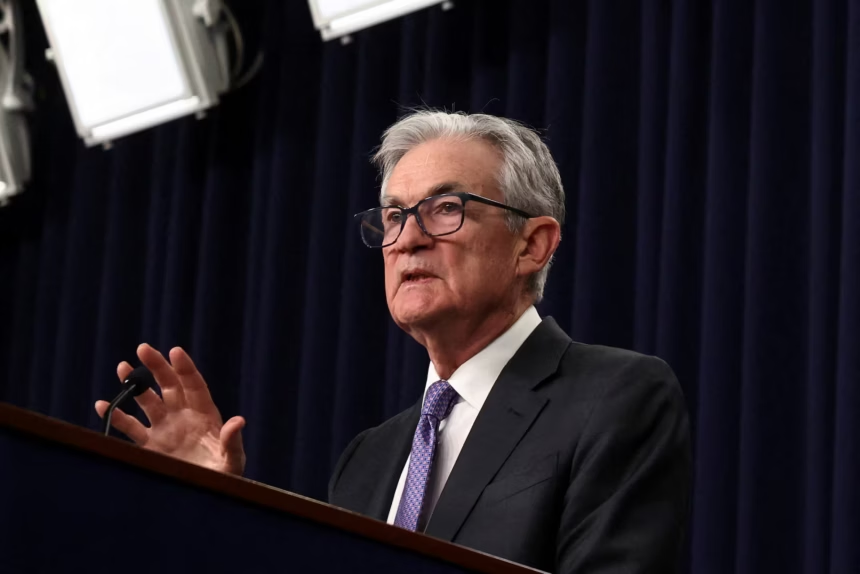
The show of international support followed Powell’s own remarks on Sunday confirming that prosecutors are investigating a $2.5 billion renovation of the Federal Reserve’s headquarters in Washington, D.C., as well as his related testimony before Congress. Powell said the inquiry came amid escalating political pressure over monetary policy.
Powell, who has repeatedly resisted calls from Donald Trump to cut interest rates more aggressively, suggested the investigation reflects frustration within the White House over the Fed’s stance. In a video statement posted on the Federal Reserve’s official account on X, Powell said the threat of criminal charges stems from the central bank’s refusal to align policy decisions with presidential preferences.
“The threat of criminal charges is a consequence of the Federal Reserve setting interest rates based on our best assessment of what will serve the public, rather than following the preferences of the President,” Powell said.
He warned that the outcome of the investigation could have far-reaching implications for U.S. monetary policy.
This is about whether the Fed will be able to continue to set interest rates based on evidence and economic conditions,” Powell said, “or whether instead monetary policy will be directed by political pressure or intimidation.”
The investigation and the unprecedented international response have intensified debate over the independence of the Federal Reserve at a time of heightened political and economic tension in the United States.